⚠️ SAFETY UPDATE (May 26th, 2026):
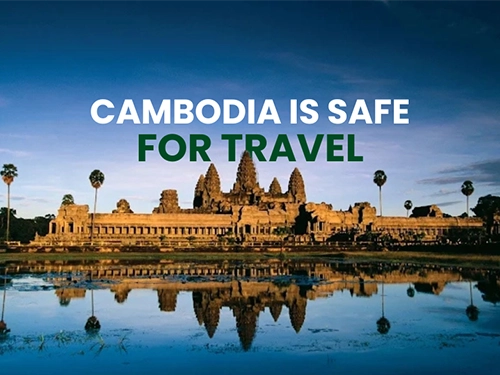
Yes, Cambodia remains completely safe for mainstream travel, including popular tourist destinations like Siem Reap, Angkor Archaeological Park (Angkor Wat), Phnom Penh, and the southern islands. However, due to the lingering effects of the recent armed conflict along the Cambodia-Thailand border, all land border crossings between the two countries remain closed to foreign travelers.
Strict government exclusion zones remain active directly at the border. If you are planning a trip, you must fly into the country rather than attempting an overland crossing from Thailand.
Table of Contents
- The Conflict: What is Happening Right Now?
- No-Go Zones: Areas You Must Avoid
- Is Siem Reap (Angkor Wat) Safe?
- Safe Zones: Where You Can Still Go
- Essential 2026 Entry Requirements (Don’t Skip These!)
- FAQs About the Current Crisis
The Conflict: What is Happening Right Now?
The severe territorial dispute that escalated into military strikes and civilian evacuations in late 2025 and February 2026 has stabilized. While a formal ceasefire is technically holding, the border remains highly militarized and fraught with tension.
- Active Fighting? : There are currently no ongoing airstrikes or active artillery shelling reported. However, sporadic border skirmishes and a massive military presence mean the frontier remains volatile.
- Border Closures: Major land checkpoints (such as Poipet, Cham Yeam, and O Smach) are completely suspended for international tourists. Do not try to book overland buses or tuk-tuks connecting Bangkok to Siem Reap. As of today, “Prime Minister Anutin Charnvirakul confirmed that border checkpoints between Thailand and Cambodia will remain closed.“
No-Go Zones: Areas You Must Avoid
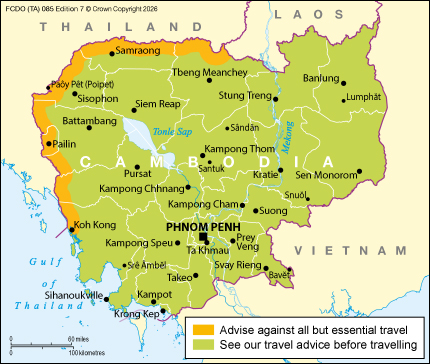
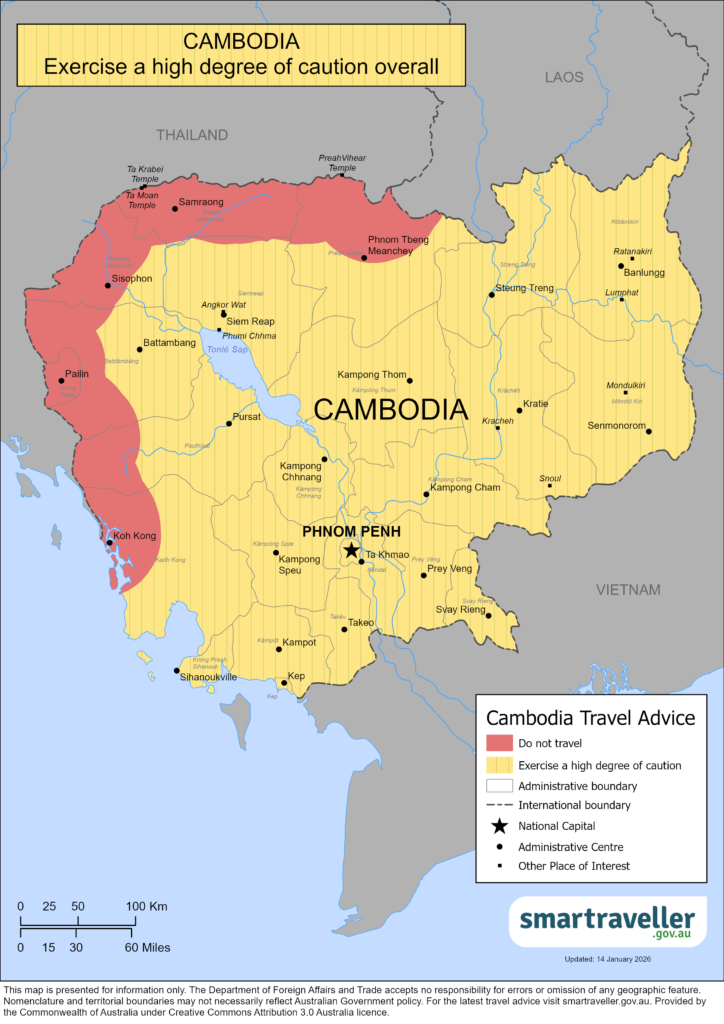
Western governments have uniform warnings against traveling to the immediate frontier. You must strictly avoid the following border provinces within 20–50km of the Thai border:
- Preah Vihear Province (The Preah Vihear Temple complex remains closed to tourists).
- Oddar Meanchey * Banteay Meanchey (Including the immediate vicinity of the Poipet border crossing).
- Pursat’s western border areas.
Note: Border-area tourist sites like Khao Phra Wihan/Preah Vihear temple, Ta Kwai/Ta Krabey temple, and Ta Muen Thom temple remain entirely closed.
Is Siem Reap (Angkor Wat) Safe?
Status: 100% Safe and Operational Siem Reap sits roughly 150km to 250km away from the restricted border zones and is completely untouched by the border tensions. Daily life, night markets, and tours inside the Angkor Archaeological Park are running perfectly normally.
- Flights: Siem Reap Angkor International Airport (SAI) is operating fully.
Safe Zones: Where You Can Go
The vast majority of Cambodia is entirely insulated from the border issues and functions normally:
- Phnom Penh: The capital is safe and peaceful. Note: The US Embassy recently reminded travelers to stay vigilant against petty crime (bag/phone snatching) in crowded riverside or BKK areas, especially during major public holidays.
- Sihanoukville & The Islands (Koh Rong / Koh Rong Sanloem): Operating completely as normal. Beach tourism and boat transfers face no disruptions.
- Kampot & Kep: Safe, calm, and highly recommended for travelers seeking a peaceful countryside vibe.
Essential 2026 Entry Requirements (Don’t Skip These!)
If you are flying into Cambodia this month, there are two mandatory digital steps you must take:
- Cambodia e-Arrival Card (CeA): You must complete and submit an electronic e-Arrival Card online (via
arrival.gov.kh) within 7 days prior to your arrival. This officially replaces the old paper immigration cards. - FPCS Registration: The Cambodian government requires all foreign nationals to be logged into the Foreigners Present in Cambodia System (FPCS). Ensure your hotel or guesthouse scans your passport and registers your stay upon check-in.
FAQs About the Current Crisis
Q: I have a flight to Siem Reap tomorrow. Should I cancel?
A: Check with your airline first. If the flight is operating, it is technically possible to go, but you risk getting stuck if the airspace closes. Many travelers are rerouting to Phnom Penh or cancelling.
Q: Is there a risk of the fighting spreading to Phnom Penh?
A: It is highly unlikely. The conflict is territorial, focused on the border demarcation lines. Phnom Penh is far from the front lines.
Q: What should I do if I am currently in a border province?
A: Leave immediately. Move south toward Siem Reap city or Battambang city.
Q: What does the embassy say?
A: For a precise alert, please reach out to your respective embassy.
U.S. Embassy in Cambodia: Maintains a Level 2 (“Exercise Increased Caution”) travel advisory for the country overall, but issues a strict “Do Not Travel” mandate for the immediate areas along the Cambodian-Thai border due to the recent armed conflict.
Ambassade de France au Cambodge
Embassy of Malaysia: avoid non-essential travel to Preah Vihear, Oddar Meanchey, Banteay Meanchey, Battambang and Pursat Provinces.
Australian Department of Foreign Affairs and Trade (SmarTraveller): Recommends exercising a “High Degree of Caution” in Cambodia overall due to security risks. They explicitly maintain a “Do Not Travel” advisory to any areas within 50 kilometers of the Cambodia-Thailand border due to the threat of armed violence and landmines.
Foreign, Commonwealth & Development Office UK: Advises against all but essential travel to within 20km of the land border with Thailand. They note that while a ceasefire was signed, the situation remains tense, land borders are suspended, and tourist sites at the border are closed.
Safety First, Adventure Second.
Cambodia is still safe to travel to. If you are already in the country, move from the border and head south to Phnom Penh or the islands. If you are planning a trip, we strongly advise you to postpone visits to the border regions until the ceasefire is restored.
Stay safe, stay informed, and keep your embassy’s emergency number on speed dial.